 Return to sub menu
This is an article from The Stockade, Volume 4, Spring 1974, p4-5. Compiled by Sue Atkins
During the year 1846 the threat to the Wellington District of Maori raiding parties under the two turbulent chiefs, Te Rauparaha and Te Rangihaeta, caused the Karori settlers to prepare against attack and build the Karori Stockade.
The climate of opinion in the area is illustrated by this letter written 2nd June 1846 by the officer in charge of the Wellington militia and sent to the Colonial Secretary in Auckland:
Sir
Since my last communication of 19th ultimo I regret to state that the alarm and excitement both in the Town and District has not in the least abated arising from the numerous reports of intended attacks by the Rebel Natives. So great is the panic that nearly all agricultural and other occupations which lead to exposure have been abandoned and many families have left their homes in the Country to seek protection in the Town and other places of security. These rumours generally reach me through the friendly Natives, and although I do not place implicit confidence in them, yet it is necessary that every precaution should be taken in order to allay apprehension. I have therefore in addition to the Militia force already reported embodied thirty men for the Karori District, which has been threatened, and likewise removed the Ohariu Party of Police from this isolated and dangerous position to that District, where a Stockade is about to be erected which will not only afford security to the settlers there, but be an additional protection to the Town, the force in which has been strengthened by two companies of volunteers, one consisting of one hundred men and the other of eighty.
(From the National Archives).
The site chosen for the defence post was an elevated clearing surrounded by dense bush continuing without a break to the summit of Johnson's Hill, and from all accounts, appears to have been on the right hand side of today's Lancaster Street, looking south from the junction with the Main Road. Surrounded by a trench, the stockade was about thirty feet long and twenty feet wide, made of rimu and miro logs measuring ten feet in height and hewn into points at the top, thus forming a bullet-proof wall around the small house that was built as a shelter inside. This small house was divided into two rooms -- one for men of the garrison and the other for the women and children of the settlement.
James Cowan's The New Zealand Wars gives the following description of the stockade:
Loopholes for musket fire were made by cutting timbers before they were set in the ground, between two and three feet apart, and measured about five inches in length vertically by three inches in width. Between the foot of the stockade and the surrounding small trench there was a space of three to four feet; the earth from the trench was then packed firmly against the base of the timbers. The space thus left enabled the sentries on duty at night to walk around the post between trench and wall. The doorway in the stockade faced south; the door was of thick slabs, and for want of iron hinges, it was pivoted on timber sockets, after the manner still seen in some remote settlements. Within the stockade the settlers built a little house .... In one corner was a fireplace of clay. The floor was the bare earth. There was a clear space of ten feet all round between this house and the stockade wall.
The stockade was built by the Karori Militia, a party of bluejackets from HMS Calliope, and a detachment of armed police from Wellington. During the day, the settlers worked on their holdings with rifles and ammunition handy in case of a surprise attack, and by night they guarded the stockade in groups of ten.
The expected attack did not eventuate in Karori, however, and it seems the stockade was later used as a church, as the following report of the great land sale at Karori in 1888 indicates:
An instrumental open air concert on the land was held on Saturday previous to the sale commencing at 2.30 p.m. The members of the band discoursed their sweet strains from historic ground - the knoll upon which the blockhouse and fort were erected in troubled times when Wellington was threatened with Native foes and from which the late Bishop Selwyn preached more than one sermon of faith, hope and courage, being utilised as a bandstand.
( J. J. Bostall "Notes on Karori, Makara, and Port Nicholson").
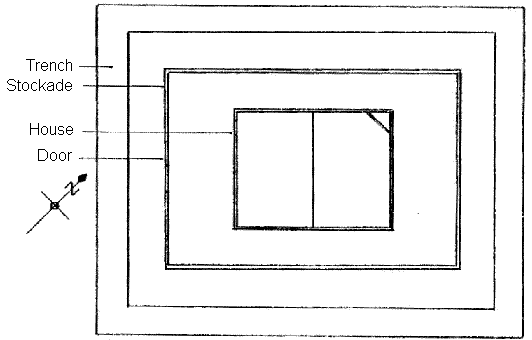
Plan of Stockade